FinRL vs FinRL-X in 2026: Which RL Trading Framework to Use and How to Stress-Test Its Backtest
If you’re building a reinforcement-learning trading pipeline in 2026, you now face a fork in the road: the original FinRL library, or its successor FinRL-X. This guide compares both, shows what each is actually for, and gives you five concrete checks to run before trusting any backtest either one produces.
How This Guide Was Built
This is a desk-research guide built entirely on primary sources fetched 2026-10-14 (all HTTP 200): the FinRL-X arXiv paper, the AI4Finance Foundation research page, and the official FinRL and FinRL-Trading GitHub repos. We did not run either library in-house, executed no code, and performed no independent backtests; all performance figures cited are the authors’ self-reported numbers, explicitly labeled as such throughout.
That last sentence matters. Every Sharpe ratio, drawdown, and return figure in this post traces to a repo README written by the frameworks’ authors; the arXiv abstracts carry no performance figures. Where a number is self-reported, we say so. Where the evidence is thin — and in one case it is very thin — we flag it.
The Short Answer — Use FinRL to Learn, FinRL-X to Build
The original FinRL library is best for education, benchmarking, and DRL research prototyping — its own README says so and redirects production users to FinRL-X — while FinRL-X is the 2026 AI-native, modular, weight-centric stack for building and deploying strategies, per its arXiv 2603.21330 paper and the AI4Finance Foundation.
This isn’t a “which is better” question so much as a “which is better for what” question. The two projects have deliberately different jobs, and the maintainers say so themselves.
What the Original FinRL Still Does Best
The original FinRL is a beginner-friendly deep-reinforcement-learning library covering DQN, DDPG, PPO, SAC, A2C, and TD3 across NASDAQ-100, DJIA, S&P 500, HSI, SSE 50, and CSI 300, with transaction cost, liquidity, and risk-aversion built into its environment, as described in its arXiv 2011.09607 paper.
Six years after its NeurIPS 2020 DRL workshop debut, it remains the fastest way to get a DRL trading agent running end-to-end.
Algorithms, markets, and the three application demonstrations
The library wraps six standard algorithms — DQN, DDPG, PPO, SAC, A2C, and TD3 — and covers six market datasets. The original paper structures the library around three application demonstrations: single-stock trading, multiple-stock trading, and portfolio allocation. For a team learning how DRL maps onto trading problems, that’s a complete curriculum in one package.
Ecosystem anchors
The PyPI finrl package is published, finrl.readthedocs.io hosts the API docs, and the library builds on Stable-Baselines3 (repo) for its algorithm implementations. The README describes 14 manually-wired data processors. If your team already knows Stable-Baselines3, the learning curve is short.
The limits the repo states itself
The FinRL README is explicit: this is “the original FinRL library for education, benchmarking, and research prototyping,” and it redirects users to FinRL-X for “the next-generation AI-native and production-oriented trading stack.” It ships under an MIT license, and as of the 2026-10-14 snapshot it shows 16.6k stars and 3.5k forks. The README also says: “Recommended for new users: Start with FinRL-X” — by its own framing, not the production tool.
What FinRL-X Adds — Architecture and the Weight-Centric Contract
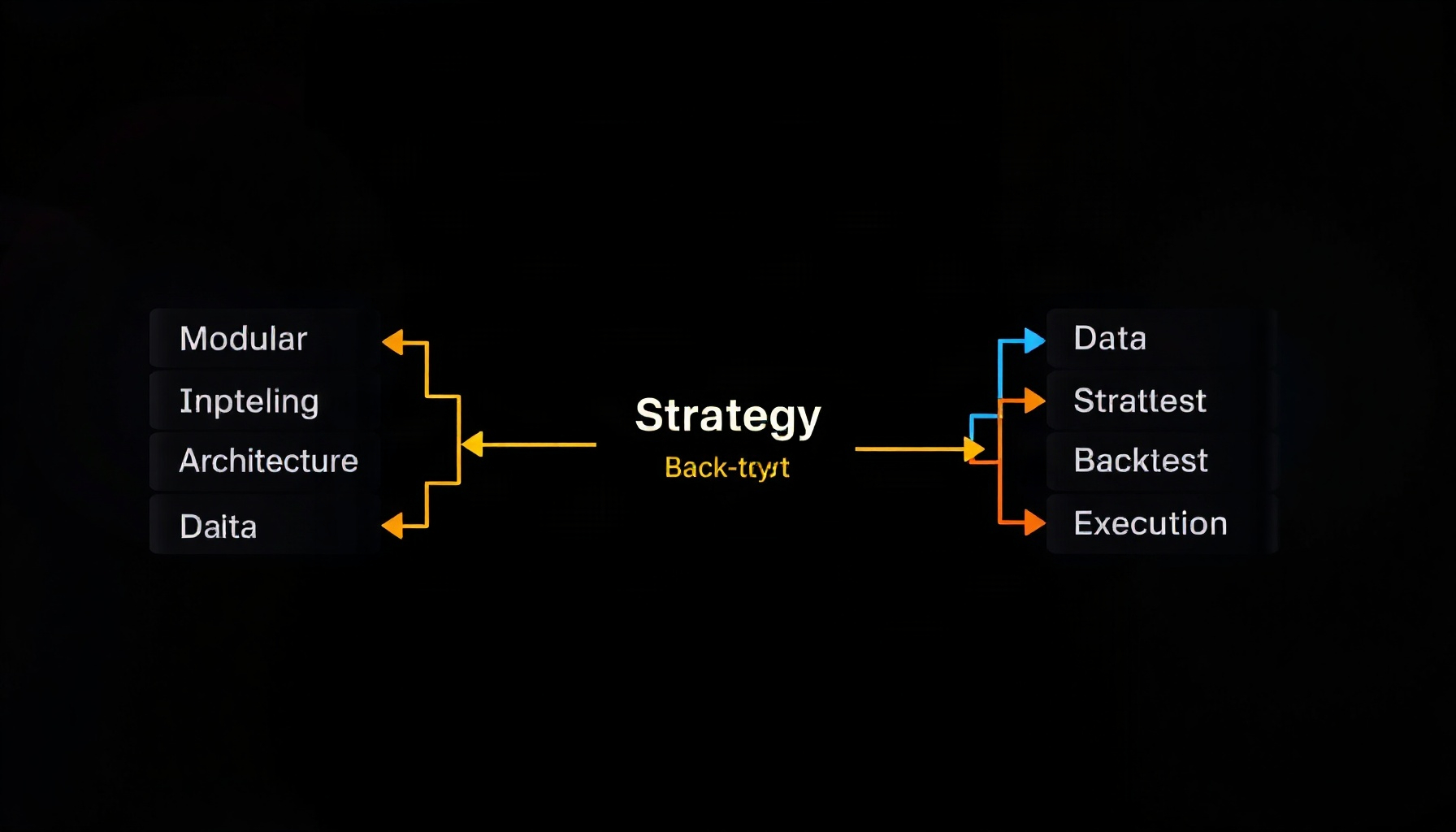
FinRL-X replaces FinRL’s DRL-only coupled monolith with an AI-native, decoupled modular stack (ML + DRL + LLM-ready) built around a weight-centric contract, w_t = R_t(T_t(A_t(S_t(X_≤t)))), where S is stock selection, A allocation, T timing, and R risk overlay, per the FinRL-X paper and the FinRL-Trading repo.
Every strategy, classical or learned, decomposes into the same four composable stages, and the output is always a portfolio weight vector.
The four layers
The repo’s architecture table maps cleanly:
- Data layer: FMP, Yahoo Finance, WRDS, LLM sentiment preprocessing, and a SQLite cache.
- Strategy layer: stock selection, portfolio allocation, timing, and a risk overlay — the four stages of the weight-centric contract.
- Backtest layer: a
bt-powered engine with transaction costs. - Execution layer: Alpaca multi-account with pre-trade risk checks.
The decoupling is the point. In original FinRL, the Gym environment couples data, strategy, and simulation. FinRL-X’s layers are separable, which means you can swap a DRL allocator for Markowitz without touching your data pipeline or execution path.
Classical allocators as first-class citizens
FinRL-X ships Equal Weight, Markowitz Mean-Variance, Minimum Variance, a DRL Allocator (PPO/SAC producing continuous weights), and KAMA Timing as peer strategies. This is a meaningful shift: instead of assuming DRL is the answer, the framework lets you benchmark DRL against classical allocation on identical data and the same risk overlay.
The “Evolution from FinRL” table
The FinRL-Trading README includes an explicit evolution table: FinRL (2020) is DRL-only, a coupled monolith with Gym state/action spaces; FinRL-X (2026) is AI-native (ML + DRL + LLM-ready), with decoupled modular layers and the weight-centric contract. If you’re evaluating architecture, that table is the honest summary of what changed.
Supersedes five papers
Per the AI4Finance Foundation page, FinRL-X “supersedes and consolidates” five earlier FinRL papers: arXiv 2011.09607 (the FinRL library, NeurIPS 2020 DRL workshop), 2111.09395 (the FinRL framework, 2021), 2112.06753 (FinRL-Meta, 2021), 2211.03107 (FinRL-Meta benchmarks, NeurIPS 2022 Datasets & Benchmarks), and 2304.13174 (dynamic datasets, 2023). If you’ve been tracking the FinRL literature, FinRL-X is the consolidation point.
Getting started
The README gives a one-command backtest:
./deploy.sh --strategy adaptive_rotation --mode backtest --start 2023-01-01 --end 2024-12-31And a paper-trading dry run:
./deploy.sh --strategy adaptive_rotation --mode paper --dry-runDirect strategy execution uses python src/strategies/run_adaptive_rotation_strategy.py --config src/strategies/AdaptiveRotationConf_v1.2.1.yaml --backtest. Configuration lives in a .env file with APCA_API_KEY, APCA_API_SECRET, APCA_BASE_URL (paper URL https://paper-api.alpaca.markets), and an optional FMP_API_KEY.
FinRL vs FinRL-X at a Glance
| Dimension | FinRL (original, 2020) | FinRL-X (2026) |
|---|---|---|
| Purpose | Education, benchmarking, research prototyping (per README) | AI-native, production-oriented trading stack |
| Approach | DRL-only, coupled monolith, Gym state/action spaces | ML + DRL + LLM-ready, decoupled modular layers |
| Core abstraction | Gym environment | Weight-centric contract w_t = R_t(T_t(A_t(S_t(X_≤t)))) |
| Classical strategies | Not first-class | Equal Weight, Mean-Variance, Min Variance, KAMA Timing alongside DRL allocators |
| Backtest | Research environments | bt-powered engine with transaction costs |
| Execution | Basic Alpaca support (live trading) | Alpaca multi-account, pre-trade risk checks, paper mode |
| Data | 14 manually-wired processors | FMP, Yahoo, WRDS, LLM sentiment preprocessing, SQLite cache |
| License | MIT | Apache-2.0 |
| Community (snapshot) | 16.6k stars, 3.5k forks, 3,284 commits | 3.8k stars, 1.1k forks, 322 commits |
| Key paper | arXiv 2011.09607 | arXiv 2603.21330 |
The Self-Reported Numbers — Read Them as Marketing, Not Evidence
The FinRL-X authors report two strategies on their own data. Adaptive Rotation (backtest Jan 2018–Oct 2025): Sharpe 1.10, max drawdown -21.46%, Calmar 1.04, 22.32% annualized, versus QQQ at Sharpe 0.81 / -35.12% and SPY at Sharpe 0.72 / -33.72%. Rolling Strategy over the same backtest: Sharpe 0.93, max drawdown -38.95%. Separately, an ensemble of Rolling Selection plus Adaptive Rotation ran on Alpaca paper trading from Oct 2025 to Mar 2026 with Sharpe 1.96 and +19.76%. These are author-reported figures from the FinRL-Trading repo, not independently verified here.
Why the paper-trading Sharpe of 1.96 should not be trusted on a ~6-month window
A Sharpe ratio is a signal-to-noise estimate, and six months of returns is very little signal. The repo reports this as a single paper-trading window. Over that same window SPY returned -2.51% and QQQ -4.79%. A strategy posting +19.76% while its benchmarks fell could reflect skill, regime luck, or both. There is no way to distinguish those on a single 6-month sample, and this guide makes no attempt to.
No independent replication exists in this desk research
The DRL-vs-classical comparison in FinRL-X’s benchmark uses the author’s data, the author’s window, and the author’s implementation. As of 2026-10-14, this desk research found no independent replication of any FinRL-X performance figure. That doesn’t mean the numbers are wrong; it means they are unverified by anyone without a stake in the outcome.
Five Checks Before You Trust Any Backtest from Either Framework
Before trusting any backtest, verify no-lookahead semantics (FinRL-X claims “strict no-lookahead” for its rolling selection — verify it in code), confirm transaction costs are on, check benchmark choice (state which baseline a claim uses), scrutinize the sample window, and audit survivorship bias in the NASDAQ-100 universe — checks motivated by the caveats the FinRL-X repo itself surfaces.
Run these five checks on any backtest, from either framework, before it influences a single allocation decision:
- No-lookahead audit. Data leakage hides in three places: the selection step (using full-period statistics to pick the universe), feature construction (rolling windows that accidentally include the current bar), and normalization (scalers fit on the full sample). FinRL-X’s rolling strategy claims strict no-lookahead semantics for its quarterly top-25% NASDAQ-100 selection — verify that claim in the code yourself, because “strict no-lookahead” is a README assertion, not a proof.
- Transaction costs and liquidity. FinRL’s original paper claims transaction cost and market liquidity are incorporated; FinRL-X’s
btengine claims transaction costs. Confirm the actual cost assumptions in configuration — a strategy that looks great at zero cost can die at realistic spreads. - Benchmark and universe choice. On the author’s Jan 2018–Oct 2025 window, Adaptive Rotation’s Sharpe of 1.10 sits above QQQ’s 0.81 and SPY’s 0.72 (author-reported). That gap is exactly what a baseline choice can move, so always state which benchmark the comparison uses.
- Sample window and regime coverage. A Jan 2018–Oct 2025 backtest covers multiple regimes; a 6-month paper-trading window covers one. Demand that reported Sharpe ratios come with the window they were computed on, and distrust any number that doesn’t.
- Survivorship in the NASDAQ-100 universe. FinRL-X’s rolling strategy selects the quarterly top-25% of NASDAQ-100 by ML fundamental scoring. Ask whether the universe is constructed with point-in-time index membership. Selecting today’s top names and backtesting them backward is textbook survivorship bias.
FAQ
Is FinRL still maintained in 2026?
The FinRL repo is still public and hosted, with 16.6k stars at the 2026-10-14 snapshot, but it positions itself for education and prototyping and points users to FinRL-X/FinRL-Trading for production work.
Can I go from FinRL-X backtest to live trading directly?
FinRL-X ships an execution path — Alpaca multi-account with pre-trade risk checks and a paper-trading --dry-run mode via Alpaca’s trading API — but this guide did not test it in-house, and the authors’ own paper-trading evidence spans only ~6 months, so treat live deployment as unproven.
Which one should a quant team pick for research vs production?
Use the original FinRL for teaching DRL and reproducing benchmarks (DQN through TD3, per arXiv 2011.09607), and FinRL-X for production-oriented pipelines where classical allocators, risk overlays, and execution are first-class — matching the repos’ own stated positioning.
The Bottom Line
Pick the original FinRL for learning and DRL baselining, FinRL-X for building a modular, weight-centric pipeline with classical and DRL allocators plus execution — and regardless of choice, treat every published Sharpe (including FinRL-X’s self-reported 1.10 backtest and 1.96 paper figures) as a hypothesis to replicate, not a result to trust, per the FinRL-X repo and AI4Finance Foundation.
The maintainers’ own READMEs point in two directions: FinRL’s says education and prototyping and recommends new users start with FinRL-X, while FinRL-X describes a production-oriented stack and still carries an “educational and research purposes only” disclaimer. Your job is to pick the tool matching your stage — then earn your own numbers by running the five checks above on your own data, your own window, and your own cost assumptions.
Disclaimer: Nothing herein constitutes financial advice. Both the original FinRL and FinRL-X are research and engineering tools; trading involves risk of loss, and any strategy — including those built with these frameworks — should be independently validated before deployment.
← Back to all posts