CRM Stock Analysis: Agentforce AWU vs. cRPO Inflection
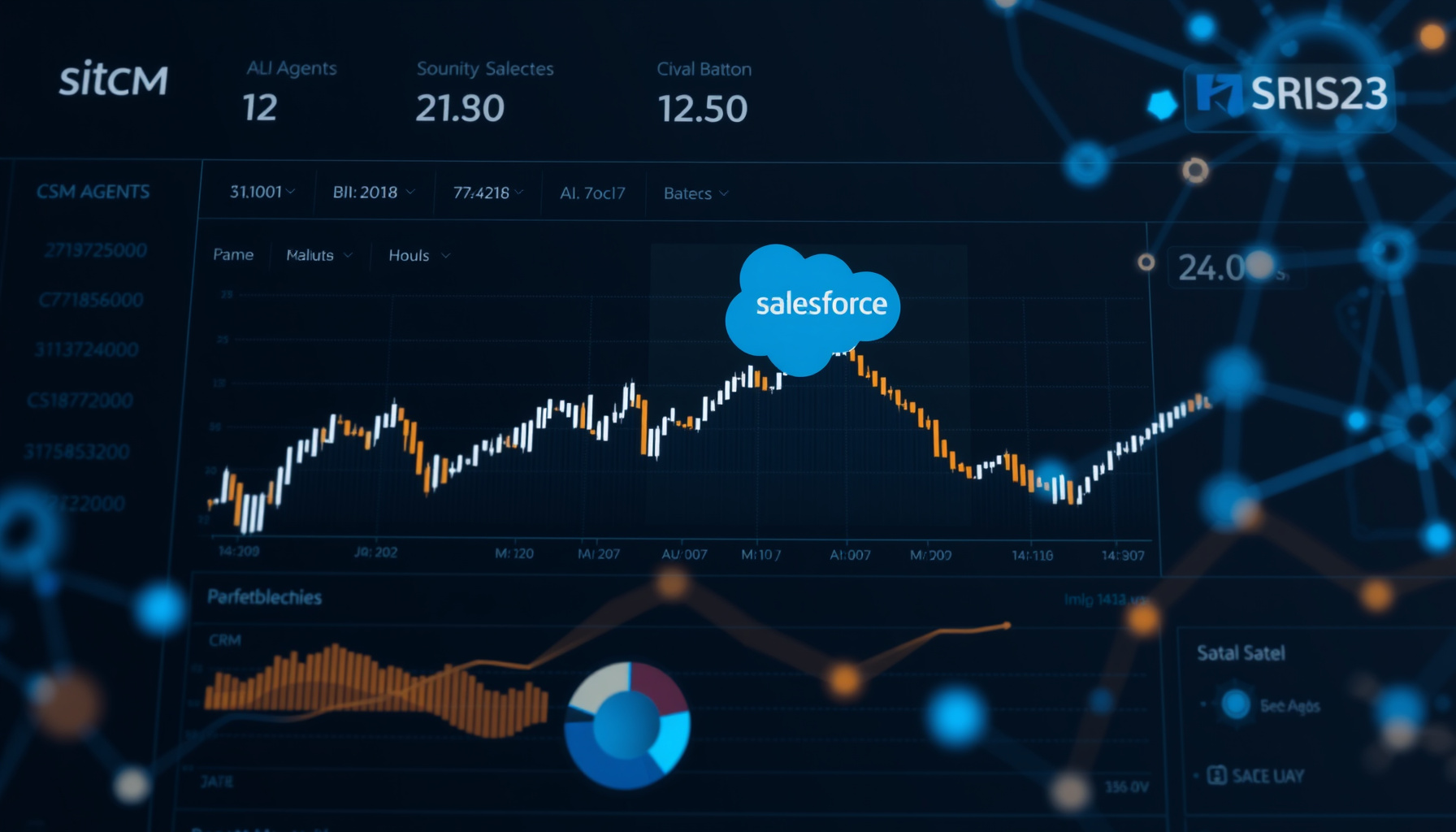
This CRM stock analysis anticipates the Q2 FY2027 earnings report on August 26, 2026, post-close. The central question for quantitatively-minded investors is whether Salesforce’s Agentforce AI billing model will monetize fast enough to drive a re-acceleration in its crucial current remaining performance obligations (cRPO) growth, setting up the post-earnings move.
How This Was Researched
This analysis synthesizes data from official Salesforce Q1 FY2027 press releases via CNBC and the Salesforce IR quarterly results page, primary documentation from salesforce.com/agentforce, analyst commentary via CNBC and DefenseWorld, and consensus data from StockAnalysis, MarketBeat, and ad-hoc-news. Technical levels derive from Yahoo Finance daily closes through August 19, 2026; guidance and pipeline metrics come from the Q1 call transcript and previews like Hudson Labs. We did not model intraday options flows or build ML forecasts — conclusions are limited to the structured data above. Last researched: August 2026. This analysis is based on official filings, press releases, and published reports — we did not run live trading experiments.
What is the core analytical tension in this CRM stock analysis?
The core tension is a race between monetization mechanisms: Agentforce’s consumption-based AWU billing showing rapid traction versus cRPO — the forward growth indicator that anchors valuation — staying flat at 14% YoY in Q1, per TechTimes. The bull case hinges on the former, the bear case on the latter.
Chart Analysis: Key Technical Levels Ahead of Earnings
CRM trades at $206.09, above the 20-day ($187.87), 50-day ($173.23), and 200-day ($201.36) moving averages with RSI(14) at 64.8, per Yahoo Finance closes through August 19, 2026. The 52-week range is $146.32–$269.11 and YTD is -18.7%.
The institutional support zone between $183.10 and $202.38 has produced an average peak gain of 51% across four prior tests, per TechTimes. For comparison, see our NFLX technical framework for how we structure similar levels.
The Agentforce AWU Billing Model Deep Dive
Agentforce bills per AWU — one complete intent-to-response cycle equals one AWU — a shift from per-seat licensing to consumption-based AI pricing, per Salesforce Agentforce Docs. Salesforce runs three concurrent pricing models (per-conversation, flex-credit, per-user), creating revenue-recognition complexity as AWU consumption may lag cRPO bookings.
An efficiency-deflation risk looms: better AI models may require fewer AWUs per task, pressuring unit economics. Q1 showed Agentforce ARR at $1.2B (+205% YoY) and 3.8B AWUs (+111% QoQ), per the Q1 call transcript.
Bull Case: Why CRM Could Rip Post-Earnings
The bull thesis points to visible monetization of the AI and federal pipeline: a VA contract worth $1.6B over 3 years and a $5.6B 10-year Army deal via Computable Insights, per CNBC. Agentforce’s top customers raised spend 1.5x YoY, with over 60% of Agentforce/Data Cloud Q4 FY26 bookings from existing customers.
Q1 non-GAAP operating margin hit 34.8% against a full-year guide of 34.3%, and CRM trades at ~21.4x trailing P/E versus the S&P 500 median of 23.8, with a ~0.9% dividend yield. Short interest fell 36.7% in July, and the consensus price target is $241.72 from 53 analysts with a Buy rating, per StockAnalysis. This setup resembles our Oracle deep analysis where catalysts drove re-rating.
Bear Case: Key Risks in This CRM Stock Analysis
The bear case argues Agentforce momentum is not yet materializing in cRPO: Morgan Stanley downgraded CRM to Equal Weight with a $185 target, citing a slow AI monetization path, per CNBC. KeyBanc’s CIO survey data is negative, and weakness persists in Marketing, Commerce, and Tableau.
The USDA is tapping C3 AI to reduce its Salesforce footprint, and Gartner predicts 35% of point-product SaaS will be replaced by AI agents by 2030. Per-seat licensing has fallen to ~15% of enterprise contracts from 21%. Leadership churn adds uncertainty — Miguel Milano was promoted to COO while Srini Tallapragada stepped down August 5. UBS warned Salesforce may temper its H2 acceleration outlook, per DefenseWorld. For broader SaaS risk framing, see our sector research.
The Earnings-Event Playbook
The earnings playbook brackets a binary event: enter long above $202.38 (200-day SMA) with a stop at $193, targeting $241.72 consensus, if cRPO re-accelerates and Q3 guidance implies organic re-acceleration; short below $193 targeting $183.10 if cRPO stalls or H2 outlook is lowered.
Analyst targets bracket the range: UBS $210, Wells Fargo $205, Morgan Stanley $185, per DefenseWorld. This is a hypothetical quant framework, not a recommendation — see our research hub for similar pre-earnings playbooks.
Catalysts and Risks Beyond Q2
Beyond Q2, the FY27 revenue guide is $45.9B–$46.2B (+11%) with non-GAAP operating margin at 34.3% and OCF/FCF growth of +4-5% reflecting the $25B ASR debt, per MarketBeat. Informatica contributes ~3 points of growth.
Q2 guides are crucial: cRPO ~14%, GAAP EPS $1.74–$1.76, non-GAAP EPS $3.25–$3.27, revenue $11.27B–$11.35B versus consensus $11.33B (StockAnalysis). The post-earnings narrative hinges on whether the consumption AWU model pulls forward or depresses cRPO recognition relative to bookings.
What to Watch on the August 26 Call
The earnings event reduces to a short checklist of quantifiable signals. First, cRPO growth: a print at or above 14% YoY with sequential improvement signals that Agentforce bookings are converting into forward revenue. Second, Agentforce ARR disclosure: Q1 landed at $1.2B (+205% YoY); the market wants to see that number compound rather than plateau, because ARR growth is the leading indicator for the AWU-to-cRPO conversion debate. Third, AWU consumption metrics: 3.8B AWUs (+111% QoQ) set the baseline; watch for commentary on utilization per customer and whether efficiency gains from newer models are compressing AWU volumes. Fourth, the Q3 guide: management’s implied cRPO trajectory and any tempering of the H2 acceleration language that UBS warned about. Finally, Informatica contribution and federal pipeline updates — the VA and Army contracts provide the clearest visibility into whether the AI/government narrative is converting to bookings.
Post-Earnings Scenario Matrix
The framework above maps to three discrete post-earnings paths. In the upside scenario, cRPO re-accelerates above 14%, Agentforce ARR stays on its +200%-type trajectory, and the stock reclaims and holds the $202.38 resistance zone, opening a path toward the $241.72 consensus target. In the base scenario, cRPO holds at ~14% with mixed AWU commentary; the stock chops between the $183.10 support floor and the $202.38 200-day SMA while the market waits for Q3. In the downside scenario, cRPO decelerates or H2 guidance is tempered, triggering a break below $193 toward the $183.10 institutional support floor, where the April 2026 low becomes the next reference point. Position sizing should reflect that the binary nature of the event — the gap risk around earnings means the technical levels are targets, not guarantees.
FAQ
Is CRM stock a buy before Q2 earnings?
The decision depends on conviction in the AWU-to-cRPO conversion rate. The stock’s valuation is below the S&P median with a consensus Buy rating, but Morgan Stanley is skeptical of near-term monetization. Quantitative traders might analyze the risk/reward around the $183 institutional support floor versus the consensus $241.72 target.
What is the AWU billing model and why does it matter?
The AWU (Agentforce Work Unit) billing model charges per completed AI interaction, not per user seat. This shift matters because it decouples revenue from headcount growth, potentially creating higher gross margins but introducing consumption volatility and efficiency-deflation risks as AI improves, per Salesforce Agentforce Docs.
Which technical levels are critical for a post-earnings trade?
The most critical levels are the $183.10 institutional support floor and the $202.38/200-day SMA resistance zone. A decisive break above $202.38 on volume could signal bullish momentum, while a breach below $183.10 would suggest significant bearish pressure and test the April 2026 low, per TechTimes.
What is cRPO and why do analysts track it for Salesforce?
Current remaining performance obligations (cRPO) measure the portion of contracted revenue that has not yet been recognized but is expected to be delivered in the next 12 months. It strips out the long-dated portion of backlog, making it the cleanest forward-looking growth metric for subscription software. For Salesforce, cRPO growth at ~14% YoY is the number the market anchors to because it reflects actual bookings conversion, which is why the Agentforce consumption model’s effect on cRPO recognition is the central debate.
How does the consumption AWU model differ from traditional SaaS metrics?
Traditional SaaS grows by adding seats, so revenue tracks headcount. A consumption model grows by usage, so revenue tracks AI interactions completed. That decouples revenue from headcount but introduces usage volatility: customers can throttle AWUs in a spending review, and efficiency improvements in the underlying models can reduce the AWUs needed per task. For quant traders, the practical implication is that reported revenue becomes harder to extrapolate from backlog alone, making AWU utilization and cRPO conversion the metrics that matter.
← Back to all posts